
Across the legal profession, conversations about sustainability increasingly point to the importance of everyday ways of working: how work is delegated, how technology is used, and how rest and development are supported. The Sustainability Principles emerged from these discussions, including those at the 2025 Legal Profession Symposium, as a shared framework to support healthier and more sustainable legal careers.
Built on three pillars — Appropriate Utilisation of Smart Technology, Supporting Rest and Growth, and Mindful Delegation — and underpinned by the values of Openness and Respect, the Sustainability Principles offer a common reference point for reflecting on sustainable ways of working across different practice contexts.
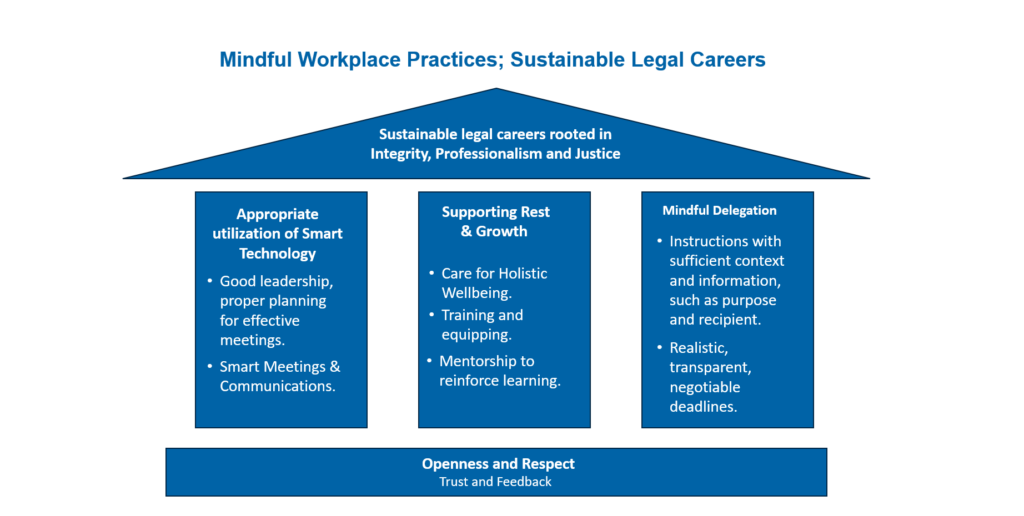
Together, these Principles offer a grounded way of thinking about how everyday choices and practices shape sustainability in legal work.
Why Sustainability Principles?
Insights gathered through conversations across the profession, including focus group discussions, surveys and discussions at the Legal Profession Symposium, surfaced a consistent theme. Many of the pressures lawyers experience are shaped not only by the volume or complexity of work, but by how work is organised and experienced on a day-to-day basis.
Questions around availability, pace, supervision and the use of technology increasingly feature in reflections on professional fulfilment and long-term career sustainability. Work by the Ethics and Professional Standards Committee similarly highlighted the importance of researching sustainable work practices and developing a set of workplace principles to support the profession in this area.
The Sustainability Principles were developed in response to these realities, providing a shared reference point to support more intentional and sustainable ways of working across different practice contexts.
What the Principles are — and are not
The Sustainability Principles are not a checklist, compliance framework, or one-size-fits-all solution. They recognise that legal practice takes place across diverse organisational settings, each with its own demands, constraints, and professional cultures.
Rather than prescribing specific outcomes, the Principles are intended to function as a reference point — supporting reflection, conversation, and small, practical shifts in everyday practice. They are designed to be interpreted and applied flexibly, in ways that are meaningful and appropriate to different teams and contexts.
How the Principles are intended to be used
The Sustainability Principles may be used in a variety of ways. For example, they can support:
- conversations within teams about workload, expectations, and supervision;
- reflection by leaders on delegation, development, and the use of technology; and
- the design of initiatives, tools, and practices that support long-term professional sustainability.
Over time, different approaches and applications will emerge as organisations and individuals engage with the Principles in ways that reflect their own practice environments.
Looking ahead
Sustainable legal careers are shaped not by a single intervention, but by cumulative everyday decisions. The Sustainability Principles provide a foundation for thinking more deliberately about those decisions — individually, within teams, and across the profession.
Subsequent initiatives and efforts will build on this foundation by exploring how these ideas can be translated into practical tools, behaviours, and lived experience in the context of legal work.
Leave a Comment