
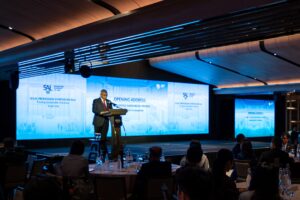
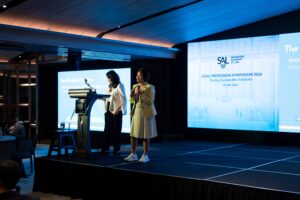
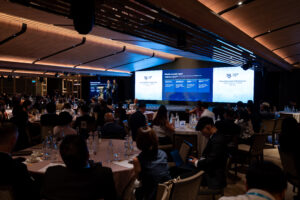
A year ago, the legal profession named its problems. This year, it looked to solutions. Close to 300 members of the Singapore legal fraternity gathered at PARKROYAL COLLECTION Marina Bay on 29 July 2026 for the Legal Profession Symposium 2026.
Under the theme “Finding Sustainable Solutions”, the Symposium built on the issues identified at LPS 2025 and the work undertaken over the intervening year. Its focus was practical: to examine, test and refine possible responses to challenges relating to internationalisation, AI integration and sustainable legal careers.
The programme brought together ideas from the Hackathon for a Better World 2026 (“Hackathon”), pre-Symposium Focus-Group Discussions and the Solutioning Workshop on 28 July which also involved Next Generation Ambassadors and Practice Group Leaders. These provided the foundation for discussions involving participants from across the legal ecosystem.
Sustaining the profession is a collective responsibility
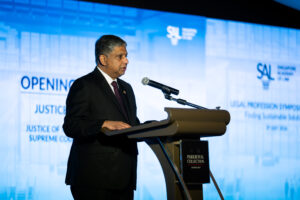
In his opening address, Chief Justice Sundaresh Menon described sustainability as the product of several connected forces, including the intensity of legal work, incentive structures, workplace culture, leadership and mentorship, and changing expectations across generations.
He noted that legal practice would remain demanding and that sustainability did not mean eliminating pressure or lowering professional standards. The question was how demanding work could be organised and carried out in a way that supported trust, respect, professional development and sustained performance.
The Chief Justice identified a number of areas in which law firms could act, including how work is allocated, how performance expectations are set, how feedback is provided, how unacceptable conduct is addressed and how opportunities for development are distributed.
He also set out the Judiciary’s role. This included engaging the profession on procedures and timelines that may create avoidable pressure, strengthening feedback channels with the Law Society and ensuring that exacting standards in court were upheld with courtesy and respect.
The work would be supported by initiatives under the Future of the Legal Profession Committee, including programmes on leadership capability, closer links between legal education and practice, the Future Lawyers Network and the Lawyers Sustainability Alliance. The Legal Profession Observatory, a joint initiative of SAL and the Singapore Management University, would provide data and empirical insights to help assess whether interventions were making a difference.
Continuing the work through the leadership transition
Chief Justice – Designate Sushil Nair affirmed his commitment to the long-term health and strength of the legal profession and to continuing the work already under way.
Drawing on his experience in law-firm management, he observed that leaders must understand the particular pressures experienced by younger lawyers. Firms required appropriate systems for distributing work and identifying when individuals were being placed under unsustainable pressure. Mentorship was also essential to developing strong teams and future leaders.
He drew a clear line against harassment and bullying, whether in legal workplaces or in court, and called on leaders to respond accordingly.
The Chief Justice – Designate also emphasised the importance of involving younger lawyers in developing solutions. The Hackathon and the Symposium were designed with this in mind: younger members of the profession had contributed ideas, analysed proposals and participated directly in shaping possible responses.
Looking ahead, he called for the profession to translate insights into action, test solutions, evaluate their outcomes and refine them using evidence and feedback.
Recognising ideas from the Hackathon
The Hackathon brought together 38 teams from across the legal ecosystem, including participants from law firms, in-house legal teams, public-sector organisations and tertiary institutions.
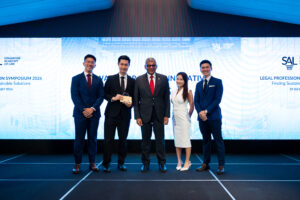
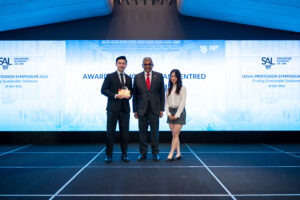
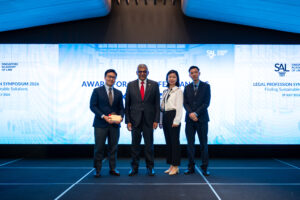
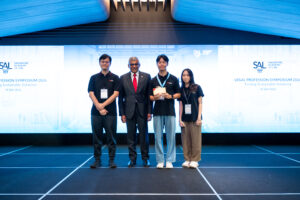
The Symposium recognised four teams:
- Misfits — Most Innovative: proposed an AI-supported learning tool that turns senior lawyers’ revisions into structured feedback, helping junior lawyers understand the reasoning behind the changes;
- Nexus Sparks — Most Life-Changing: proposed a platform combining cross-border legal knowledge, AI-assisted comparison and coordination with local counsel to support verified regional advice;
- Jereirisélle— Most Human-Centred: proposed a structured action-review framework through which supervisors and junior lawyers clarify expectations, check in during assignments, reflect on completed work and track professional development over time; and
- Chubbles — Most Feasible: proposed a tool that checks citations in legal documents against authoritative Singapore sources and flags doubtful or uncertain authorities for review.
The Hackathon submissions were treated as starting points instead of polished solutions. Selected ideas had been examined during the Solutioning Workshop through corporate and disputes perspectives before being presented at the Symposium.
Professor David Wilkins of Harvard Law School subsequently framed the main discussion, drawing together the work undertaken since LPS 2025 and the ideas emerging from the Hackathon and Solutioning Workshop.
Participants then met in 28 facilitated groups to identify priority challenges, consider possible resistance and propose practical first steps. The facilitators later reported the principal ideas from their tables for comparison and further discussion.
If this resonates, we would welcome your support in shaping the Mindful Business Movement as a community of practice — whether by adopting these approaches in how you work with external counsel, or by joining MBM as a supporting partner. If helpful, we would be glad to share more (please contact us at [email protected])
Internationalisation: capability, exposure and trusted networks
The internationalisation discussions considered different but related objectives: promoting Singapore law, helping Singapore law practices develop an international presence and strengthening the cross-border capabilities of individual lawyers.
Ideas emerging from the discussions included:
- structured secondments and exchanges with in-house teams, public-sector organisations and regional law firms;
- a maintained ASEAN jurisdiction matrix or cross-border playbook;
- trusted regional referral and coordination networks; and
- stronger business-minded, sector-specific and region-specific expertise.
Participants saw direct regional and client-side exposure as a practical means of developing commercial understanding and trusted professional relationships. Such experience could help lawyers move beyond providing isolated answers on Singapore law towards coordinating solutions across several jurisdictions.
Implementation would nevertheless require participating organisations to address cost, workload, supervision and the quality of placements. Any shared jurisdictional resource would also require sustained maintenance, clear ownership and reliable professional verification.
AI integration: building capability while preserving judgment
The AI discussions focused on both the potential of the technology and the conditions required for its responsible use.
The principal ideas included:
- practitioner-led AI training based on defined legal workflows;
- networks of AI champions supported by shared playbooks and governance guidance;
- workflow-specific procedures for reviewing and verifying AI-assisted work;
- secure experimentation support, particularly for smaller practices;
- closer alignment between legal education and AI-enabled practice; and
- stronger knowledge-management systems for retaining verified organisational learning.
A recurring concern was the effect of AI on apprenticeship. Participants discussed the risk that junior lawyers could lose important opportunities to develop legal reasoning and judgment if foundational tasks were transferred to AI without an appropriate learning framework.
Suggestions included defining competencies that lawyers should acquire independently, requiring them to interrogate and verify AI outputs and preserving structured opportunities for senior lawyers to explain strategy, corrections and professional judgment.
Participants also highlighted the human capabilities that would remain central to legal practice, including communication, negotiation, empathy, strategic thinking, commercial understanding and the ability to exercise judgment in uncertain situations.
Sustainable legal careers: connecting feedback with action
The discussions on sustainable legal careers concentrated on the everyday conditions created by leadership, workload, supervision, mentorship and workplace culture.
Ideas included:
- development-oriented 360-degree feedback for lawyers managing teams;
- credible independent channels for addressing difficult workplace issues;
- periodic pulse checks to understand changes in workplace experience;
- greater recognition of mentorship and people-management contributions; and
- using feedback to form teams with complementary technical, commercial and interpersonal strengths.
Participants stressed that collecting feedback would not be sufficient on its own. Lawyers needed confidence that information would be handled appropriately and that organisations would respond to the patterns identified.
Leadership ownership was therefore a recurring theme. Feedback mechanisms, workplace standards and mentorship initiatives were considered most likely to succeed where senior leaders participated visibly, accepted responsibility for follow-through and reviewed whether interventions had produced meaningful change.
Associate Professor Tan Seow Hon also presented Staying in the Game, a SAL-supported pilot empirical study involving 21 junior and early mid-career lawyers. The study found that helping lawyers clarify what gives their work meaning, supported by reflection and personalised coaching, could enable them to take practical steps towards more sustainable careers. It also underscored that individual efforts must be matched by supportive workplace and professional structures.
The Lawyers Sustainability Alliance (“LSA”) was also introduced as the second chapter of the Mindful Business Movement. The LSA aims to nurture a community of practice, spotlighting organisations that support sustainable legal careers, effective leadership and healthier professional relationships.
Different perspectives on implementation
The Senior Leaders Panel examined cross-border practice, AI governance and sustainable law-firm operations from the perspectives of organisations of different sizes and types.
Co-moderated by Justice of the Court of Appeal Hri Kumar Nair and Professor Wilkins, the panel was comprised of Mr Ng Kim Beng, Managing Partner at Rajah & Tann LLP; Ms Dorothy Tan, Managing Partner at Dot Chambers LLC; Ms Valerie Kong, Managing Partner at Clifford Chance; Mr Ian Teo, Managing Director at Helmsman LLC; and Mr Goh Peng Fong, Managing Director at DBS Bank.
The representation of large, mid-sized, small, in-house and international practices underscored an important consideration arising throughout the day: solutions must be capable of adaptation to different organisational circumstances.
Among the themes raised was the need for sustainability to be treated as a genuine leadership and organisational commitment, rather than as a standalone wellbeing initiative. This commitment must be reflected in day-to-day decisions concerning workload, supervision, workplace culture and the development and retention of legal talent.
Careers across the legal ecosystem
In his closing address, Minister Edwin Tong SC, Minister for Law and Second Minister for Home Affairs, raised concerns about attrition of the wider legal ecosystem.
While many lawyers leave private practice, movement into in-house roles, public service or academia does not necessarily amount to a departure from the law. The broader objective is therefore not simply to retain every lawyer within a law firm, but to sustain a strong profession in which lawyers can continue contributing through different roles and career pathways.
At the same time, this wider perspective does not diminish the need to address workplace and professional conditions that may unnecessarily drive lawyers away from particular environments.
Taking the ideas forward
The Symposium did not mark the end of the process. The ideas generated through the Hackathon, the Solutioning Workshop and the 29 July discussions will be further synthesised and considered through the Future of the Legal Profession Committee and the relevant Workstreams.
Some proposals will require further consultation, feasibility assessment or carefully scoped pilots. Others may offer opportunities for earlier implementation.
Across the three areas, several common conditions emerged. Practical interventions require clear ownership, appropriate incentives, credible safeguards and a means of assessing whether they have worked.
Finding sustainable solutions will therefore require more than identifying good ideas. It will require institutions and organisations across the legal ecosystem to test those ideas, learn from implementation and remain accountable for carrying the work forward.
Attendees who gathered on 29 July did not leave with finished answers — but with a shared responsibility to keep testing them.
Sorry, commenting is limited to SAL members. You may still register and log in with your SAL ID to participate in select polls or discussions that are open to non-members. To learn more, more information can be found on Help - Singapore Academy of Law
Login